

Poetry at our Time
0 comments
Margarita Drago (Argentina/USA)
Guardian of memory
I love this body that has long
inhabited the shadows,
that has known hardships,
abandonment, loneliness, forgetfulness,
I love this body
so often coveted by death,
so often battered
by winds from distant lands,
I love this body,
hidden treasure,
guardian of the memory of times.
A body that still beats.
To Elsa Narváez de Bazán, companion.
In memoriam.
A rigid body,
a toothless mouth that
opens and engulfs the food
offered by the hand of the lover,
a fixed gaze lost
in a strange reality,
incoherent phrases,
a thought,
a word,
a slight smile
link
fleeting connection
with a distant
shared story,
a body that demands arms
to lift it,
a body that resists becoming earth,
a body that yearns for its steps
on dusty urban spaces,
hands that draw
labyrinthine nets,
hieroglyphics with messages
from other times,
a body that refused punishment,
that renounced memories that wound,
a body that still beats,
that still stands,
that still clings to a bed,
to sheets,
to a small room,
cell, prison, guards,
a body that refuses
to share the table with
other bodies
they still have memory.
They took them
“Why pour more sorrow
on the hearts of the sorrowful?”
Rumi
The hugs were left
Clinging to the air
The served table
and the warm bread in the oven
the scream was left biting
the shadows
“they took them” “they took them”
echoes on the walls
in the empty houses
“they took them” “they took them”
whispers the air
through the desolate streets
where the despicable
threw the bodies
where the earth
conceals their gaze
where the mouths
bleed words
where the bones
shiver with cold
“they took them” “they took them”
the anxious mothers cry out
in a restless search.
Silence became long
The wait grew dark. [became dusk o turn to dark]
Bird woman
A woman, bird with broken wings,
expelled from paradise
and condemned to live in exile
in an ostentatious city
of lights, buildings and misery,
where her half life
only laid half roots,
and where along with other women,
outcast birds, like herself
weaved dreams and memories
and recomposed by the strength of
word and pen
the wings of her bruised body.
The woman overflew the seas
and landed on the shore of the promised land.
If I had another chance
“Here it happens, gentlemen,
that I play death”.
Juan Gelman
If I had another chance
I would be the same again.
I would embrace the letters
that live inside me,
I would gather the dust from my bones
and with my nazarene sandals,
witnesses of love and death,
I would begin to walk
the beaten path,
– the south, being always.
my north-
I would overfly prisons and cemeteries
to give life to death
and build paradise
in the kingdom of this earth.
If I had another chance
I would be the same again.
I would only change one detail
of the story:
I would start living the day
of my death
until I retrace the path
a December 28.
 Margarita Drago. Born in Rosario, Argentina; lives in New York since her release from prison. Professor of Spanish Language and Hispanic American Literature at York College (CUNY).
Former political prisoner and writer, she has participated in events across the Americas and Europe. Author of Fragmentos de la memoria (1975–1980) and its expanded editions (Spanish, Italian) Fragments From Prison. My Live in Two Battles, and several poetry collections. Coauthor of Tomamos la palabra: mujeres en la guerra civil de El Salvador (1980–1992).
Deputy editor of the literary biannual EntreTmas Revista Digital and co-curator (with Juana M. Ramos) of Palabra-Imagen-Escena in NYC. Her poems, stories and essays appear in anthologies and publications in the United States, Latin America, Spain and Italy.
Anjana Vipin Edakkunny
LEFTOVERS
(“According to popular legend, Bheem invented the dish aviyal to reuse leftover vegetables.”)
Her mother told her she was made from leftovers in the womb after what was required to carve
her twin brother.
She believed her.
She knew potatoes won’t kill
when cooked with the greening part
chopped off,
the oil used for frying pappadams
would be hot enough
for kondattams
even after the flame went out,
and leftover idlis can be crushed by hand
and served the next day
as upuma
when garnished with mustard seeds.
Her needles were sharp enough
to darn the holes
in school bags, clothes, and
the place where she should have stood
in the family photo.
She learned to make her own aviyal—
out of leftover vegetables,
coins that smelled of the street
and termite-gnawed syllables
of her name.
Yakshi
I wear the night
like the moon wears
the silhouette
of a rabbit.
Smelling of paalapoo
and freshly-strained rice starch,
the tips of my untied hair hiss
inches from the ground.
My laughter splinters the woods
like plucked out anklet bells hitting
stone floors.
I would never come to your house
to collect betel leaves.
I carry them with me.
And for centuries,
I have been asking you
for chunnambu.
Yet—
your eyes keep knotting with
the spaces
where my skin
meets
the white saree
while your lips carve warnings
about me.
Silver Stripes
“Decades ago,
the kitchen was a separate brick building
away from the tharavaadu
and evening lamps were lighted
in the paambinkaavu,
the front yard filled with mampoo scents—
I was sitting in my Achan’s lap
in the twilight-bitten corridors,
when three vellikettan snakes crawled up
to the red-oxide steps—
Achan clapped his hands and said,
‘The pooja is delayed this year. I’ll do the needful.’
The silver-striped snakes craned their necks
and crawled away.”
My Ammamma’s voice faded
into snores.
That night, my torchlight remained fixed
on the window latches.
The red-oxide steps,
the silver in raised necks,
the snake-headed sculptures lying face down
in the ruins of paambinkaavu
curl
to my pillow creases.
Hidimbi: The Knots of My Hunger
I never look into mirrors. I smash them.
And if it is a pool of water
I will step on it so hard
that the ripples take my face away
from my eyes.
I don’t think in reflections.
I think in knots of hunger;
of warm skin dripping
with greasy fat.
The wedding garlands hung
near the flat head
of a rusted nail.
Each night
after opening the door for him
and watching the grass take the shape
of his footprints,
I tried to gobble up darkness
on his side
of the bed
and block the moon
with my palms.
I didn’t know how to serve love
by spoonful.
So I used the ladle.
Crushed the lumps with the round end
so I could serve more.
But his plate was mostly untouched.
One morning, as my hands wrapped around an empty space,
I heard him uprooting the trees outside
and felt something green
sprouting inside.
Aduppu: The Hearth
She gathered an armload of firewood
from the back porch
still drunk on last night’s rain
and stuffed the sticks, kothumbu and dried coconut midribs
in-between three raised, black stones.
A red-tipped matchstick was struck against
the coarse side of the matchbox.
After the wood hissed for a few minutes,
orange tongues began gnawing
at the thick bark.
The blowpipe began carrying her breath
to the fire
to keep it alive.
The cloud of black smoke parted into two—
staining the sky through the chimney
and settling
in her ribs.
She saw her soot-stained face trapped
on the side of the aluminum pot—
until the rice water boiled over,
making the embers
leap up.
Anjana Vipin 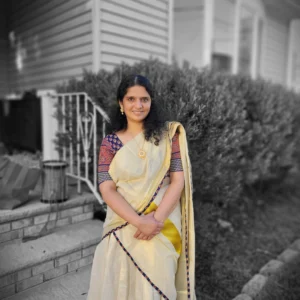 Edakkunny is a writer from Kerala, India currently residing in the United States. Her work often engages with myth, memory, and contemporary experience, tracing how they bleed into one another. Her poems have been published or are forthcoming in Target Global Magazine, Poetry Potion, Borderless Journal, PoemsIndia, Zhagaram Literary Magazine, DoubleSpeak Magazine, Inverse Journal, Ghudsavar Literary Magazine, Tap Into Poetry, Plato’s Caves Online,The Wise Owl, Housebound Magazine and Avangeline Review. Her debut collection, The Sandalwood Pyre, is forthcoming from Writers Workshop, Kolkata.
Edakkunny is a writer from Kerala, India currently residing in the United States. Her work often engages with myth, memory, and contemporary experience, tracing how they bleed into one another. Her poems have been published or are forthcoming in Target Global Magazine, Poetry Potion, Borderless Journal, PoemsIndia, Zhagaram Literary Magazine, DoubleSpeak Magazine, Inverse Journal, Ghudsavar Literary Magazine, Tap Into Poetry, Plato’s Caves Online,The Wise Owl, Housebound Magazine and Avangeline Review. Her debut collection, The Sandalwood Pyre, is forthcoming from Writers Workshop, Kolkata.Abiral
1. Pran Pratishtha
I
An ascetic — she brought
All her powers and placed
Stone upon stone under
The thorny babool
Till the words she uttered
Became a mantra
And the mantra the very
Call — I heard hung
Between here and there — now and never
Between the two shores
Of being and non being
I heard her before I knew of hearing
Before I Knew of knowing I knew her
Mother — she called me mother
With the vermillion on my stone head
And the bridal crimson wrapped about
She sang me into being.
She was all Will — that witch
Who pulled me from the
Stagnant stream of emptiness and cast me
Into the stone — a wish granter
A village deity — minor god
Of a major god chopped
Into a fitting piece shaped
Into her rough hands —
A miracle come to life
In a stone under a tree
A cosmic force come to rest
In the shape of eternity.
II
When the goddess is
not the goddess she
Walks the market road
With her jhola by her side.
She chases the street dogs
And feeds the stray cats.
She mimics the birds like
Only the birds can and
Runs up the pole like
A lizard in mid-afternoon.
And come the night like a
fly longing for the moon
She circles the lamppost till
Dawn — till she falls to the
Road exhausted and is swept
Away by the temple sweeper
And lies like a heap of garlands
From yesterday’s prayers beside
Her idol. When the first
Devotees arrive they find
The goddess with her mute smile
The priest speaks her blessing
On her behalf — live forever.
2. After Krishnamurthy
The flower isn’t there
The perfume isn’t there
There is only the flower
There is only the perfume
Only words I etch
In black ink
On blank paper
To grasp at the world
That slips every lunge
I made it.
[I am the time maker
I am in bondage to Time.]
“It is so simple when
You think of it all.”
The spell works only
On the one who
Speaks it, intones it
Worships it.
But the spell will break
The words will fade away
The world will fade away
[The watchmaker binds himself
To time, the shackles of fear
Make him count the minutes
Till all watches break
And the afternoons can melt into
The last sweet evenings.]
At last
There will be the flower
And its perfume will
Leave me bewildered.
I will know then
The nature of magic.
No surprise.
3. Of Softer Friction
The friction of clouds
In the shifting geography
Of the sky brings its breaking
Sings to the tune of cracking
A billion mirrors at once.
What is locked in the eyes
In a shutterspeedmoment
Is a glimpse of the sky
Soldered to the earth
Before the horizon’s fall.
In between is revealed
Some great being’s veins,
A mighty river’s course,
A dead tree’s rift,
An echo, or it’s call :
The rubbing of two sticks
Body upon body melting
In heat become one
Thus fire is stolen, gifted, ignited
Of softer friction.
4. Oh, Bindumati
I, a minister, a tactician, a poet
Came here with Ashoka the king,
The murderer, the penitent, the seeker.
We stood by the river flooding
Greatly worried for our city
Patliputra half submerged, half floating;
The river too was several things
Holy, wrathful, time and death
The city, our home, our pride, our roots.
And yet she heard our words.
She laughed at our worry
And said she could ask the river
To turn back upon its flow
And spare our city to us.
And how, she did too, very politely
And the river turned away from us
and took its regular course.
How, pray, you did so
We asked that great lady,
Surely you are no mere human
But a goddess who walks amongst us.
The woman said I am that
Which you know but deny
A prostitute of the streets
and yet I have known
I am nothing but the knowledge
Of who I truly am. My command
Is from my knowledge of myself
It cannot be denied
Even by the will of the gods.
And we followed her into the streets
We watched her enter the brothel
We heard her name
Claw out of the window
In amatory sighs,
Oh, Bindumati.
Abiral is a writer,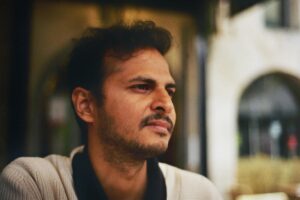 researcher, and teacher based between Berlin and Patna. He works at the university of Potsdam, Germany and enjoys writing comics books and short stories. His work has appeared in The Bombay Literary Magazine, G5A Imprint, Hindavi Bela, amongst other literary venues.
researcher, and teacher based between Berlin and Patna. He works at the university of Potsdam, Germany and enjoys writing comics books and short stories. His work has appeared in The Bombay Literary Magazine, G5A Imprint, Hindavi Bela, amongst other literary venues.