

Our Master
Nima Yushij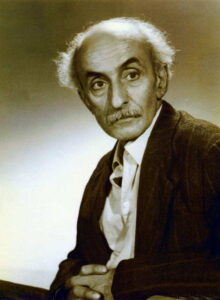
by Iraj Bashiri
Translated to English by M. Alexandrian
Nima Yushij (his real name is Ali Esfandiyari), the eldest son of Ebrahim Nuri of Yush (Mazandaran province of Iran), was born in November 1896. He grew up in Yush, mostly helping his father with the farm and taking care of the cattle. As a boy, he visited many local summer and winter camps and mingled with shepherds and itenary workers. Life around the camp fire, especially images emerging from the shepherds’ simple and entertaining stories about village and tribal conflicts, impressed him greatly. These images, etched in the young poet’s memory waited until his power of diction developed sufficiently to release them.
Nima’s early education took place in a maktab. A truant student, the mullah had to seek him out in the streets, drag him to school, and punished him. At the age of twelve, Nima was taken to Tehran and registered at the St. Louis School. The atmosphere at the Roman Catholic school did not change Nima’s ways, but the instruction of a thoughtful teacher did. Nizam Vafa, a major poet himself, took the budding poet under his wing and nurtured his poetic talent.
Instruction at the Catholic school was in direct contrast to instruction at the makteb. Similarly, living among the urban people was at variance with life among the tribal and rural peoples of the north. In addition, both these lifestyles differed greatly from the description of the lifestyle about which he read in his books or listened to in class. Although it did not change his attachment to tradition, the difference set fire to young Nima’s imagination. In other words, even though Nima continued to write poetry in the tradition of Sa’di and Hafiz for quite some time his expression was being affected gradually and steadily. Until, eventually, a time came when the impact of the new became too overwhelming. It overpowered the tenacity of tradition and led Nima down a new path. Consequently, Nima began to replace the familar devices that he felt were impeding the free flow of ideas with innovative, even though less familiar devices that enhanced a free flow of concepts. “Ay Shab” (O Night) and “Afsaneh” (Myth) belong to this transitional period in the poet’s life (1922).
In general, Nima manipulated rhythm and rhyme and allowed the length of the line to be determined by the depth of the thought being expressed rather than by the conventional Arabic meters that had dictated the length of a bayt since the early days of Persian poetry. Furthermore, he emphasized current issues, especially nuances of oppression and suffering, at the expense of the beloved’s moon face or the ever-growing conflict between the lover, the beloved, and the rival. In other words, Nima realized that while some readers were enthused by the charms of the lover and the coquettish ways of the beloved, the majority preferred heroes with whom they could identify.
Furthermore, Nima enhanced his images with personifications that were very different from the “frozen” imagery of the moon, the rose garden, and the tavern. His unconventional poetic diction took poetry out of the rituals of the court and placed it squarely among the masses. The natural speech of the masses necessarily added local color and flavor to his compositions. Lastly, and by far Nima’s most dramatic element was the application of symbolism. His use of symbols was different from the masters in that he based the structural integrity of his creations on the steady development of the symbols incorporated. In this sense, Nima’s poetry could be read as a dialog among two or three symbolic references building up into a cohesive semantic unit. In the past only Hafiz had attempted such creations in his Sufic ghazals. The basic device he employed, however, was thematic, rather than symbolic unity. Symbolism, although the avenue to the resolution of the most enigmatic of his ghazals, plays a secondary role in the structural makeup of the composition.
The venues in which Nima published his works are noteworthy. In the early years when the presses were controlled by the powers that be his poetry, deemed below the established norm, was not allowed publication. For this reason, many of Nima’s early poems did not reach the public until the late 1930s. After the fall of Reza Shah, Nima became a member of the editorial board of the “Music” magazine. Working with Sadeq Hedayat, he published many of his poems in that magazine. Only on two occasions he published his works at his own expense: “The Pale Story” and “The Soldier’s Family.”
The closing of “Music” coincided with the formation of the Tudeh Party and the appearance of a number of leftist publications. Radical in nature, Nima was attracted to the new papers and published many of his ground-breaking compositions in them.
Ahmad Zia Hashtroudy and Abul Ghasem Janati Atayi are among the first scholars to have worked on Nima’s life and works. The former included Nima’s works in an anthology entitled “Contemporary Writers and Poets” (1923). The selections presented were: “Afsaneh,” (Myth) “Ay Shab” (O Night), “Mahbass” (Prison), and four short stories. The latter published a volume dealing with the life and works of the poet (1954)
With my poetry I have driven the people into a great conflict;
Good and bad, they have fallen in confusion;
I myself am sitting in a corner, watching them:
I have flooded the nest of ants.
NIMA
*****
My House Is Cloudy
My House is Cloudy
the entire earth is cloudy.
Above the narrow pass, the shattered and desolate and drunken
wind whirls downward.
The entire world is desolated by it
so are my senses!
Oh, piper who has lost the road entranced by the melody of the flute,
where are you?
My house is cloudy but
the cloud is on the verge of weeping.
In the memory of my bright days that slipped through my fingers,
I cast a look upon my sun on the threshold of the ocean
and the entire world is desolated and shattered by the wind
and on the road, the piper continues to play his flute,
in this cloud-filled world
his own path stretching out before him.
****
Snow
Yellow hasn’t become red for no reason
the red hasn’t cast its color
upon the wall for no reason.
Morning has come from that side of the Azakoo mountains but
Vazna Mountain is not clear.
The power of the dimly-lit snow works all its chaos
on every window-pane it settles.
Vazna is not clear
from this, I have a heavy heart;
the guest-killing guesthouse’s day is dark
every soul jumbled together aimlessly:
some sleepy people
some uncouth people
some simple people.
Hey, People
Hey, you over there
who are sitting on the shore, happy and laughing,
someone is dying in the water,
someone is constantly struggling
on this angry, heavy, dark, familiar sea.
When you are drunk
with the thought of getting your hands on your enemy,
when you think in vain
that you’ve given a hand to a weak person
to produce a better weak person,
when you tighten your belts, when,
when shall I tell you
that someone in the water
is sacrificing in vain?
Hey, you over there
who are sitting pleasantly on the shore,
bread on your tablecloths, clothes on your bodies,
someone is calling you from the water.
He beats the heavy wave with his tired hand,
his mouth agape, eyes torn wide with terror,
he has seen your shadows from afar,
has swallowed water in the dark blue deep,
each moment his impatience grows.
He raises from these waters
a foot, at times,
at times, his head…
Hey you there,
he still has his eyes on this old world from afar,
he’s shouting and hopes for help.
Hey you there
who are calmly watching from the shore,
the wave beats on the silent shore, spreads
like a drunk fallen on his bed unconscious,
recedes with a roar, and this call comes from afar again:
Hey, you over there…
And the sound of the wind
more heart-rending by the moment,
and his voice weaker in the sound of the wind;
from waters near and far
again this call is heard:
Hey, you over there…
*****
Moonlight
The moon beams
the glowworm glows
sleep is seldom ruined, but
worry over this heedless lot
ruins sleep in my tearful eyes.
Dawn stands worried at my side
morning urges me to announce
its arrival to the lot.
alas! a thorn inside,
stops me in my tracks.
A delicate rose stem
which I planted with my hands
and watered with my life
its thorns break inside me.
I fumble about to open a door
uselessly expecting someone to meet
a jumble of walls and doors
crumbles over my head.
The moon beams
the glowworm glows
blisters marking a distant road
Standing before the village
a single man
knapsack on his back, hand on the knocker, murmurs
“Worry over this lot
ruins sleep in my tearful eyes.”
*
Along the Riverbank
Along the riverbank wanders the old turtle
the day’s a sunny day.
The rice-paddy scene is warm.
The old turtle basks in the warm lap of its sun,
sleep at ease
along the riverbank.
Along the riverbank there’s only me
tired from the pain of desire,
awaiting my sun.
But my eyes
cannot see it for an instant.
My sun
has hidden its face from me in the distant waters.
For me everything is clear everywhere
in my standing,
in my hurrying,
only my sun is not clear
along the riverbank.
translated by
Iraj Bashiri
****
The Soldier’s Family,
The candle burns, beside the curtain set,
So far this woman hasn’t slept yet;
Over the cradle she leans (alone),
O wretched one, O wretched one.
A few rags form the curtain of the spouse
To protect the house.
For two days no food she has tasted,
With two kids, she hasn’t rested;
One is ten, she is sleeping,
The other is awake and wailing.
She cries for her mother’s milk which is small
This is another woe, (it is dismal).
The neighbor’s child wears well,
She has her sports and eats well.
What difference is between these (I’m grieved)
What the other owns this one is bereaved.
A soldier’s child dressed in rags (and gall)
Why must she live at all?
All she sees is but asperity
What she reads, breathes adversity;
Her back is bending, with all the load,
Her eyesight is dim in this abode;
Thus she labors like a man;
Thus she toils, the woman.
The Song of the Jungle
I wonder what tumult is racking the silence of this jungle
That breeds a hundred songs of joy and sorrow in the heart;
I wonder what magic lies within the depth of jungles
That helps the jungle witch to ensnare man.
When the autumn morning sun rises,
The jungle gets so brightly lit
That it occurs to you
That each golden leaf is a candle flame
Burning in the jungle’s heart.
Which knight must bring the happy tidings of victory
For whom the jungle is adorned with lights?
When the incense-spreading gale scatters
A thousand gold coins over the jungle,
I wonder what the silent butterfly thinks
And by what melody the jungle love-bird
Sings the luring song of dropping leaves?
I like the jungle,
Because like the souls of us folks
It is full of mysterious and colorful lights and shadows.
I like the jungle,
Because a lively jungle is beautiful
And even at death it refreshes the world.
May the mirth breading jungle live long!
The Cold Stove
Surviving from very distant nights
At a silent path towards the jungle
A little stove made of stone,
Contains some cold ashes.
Like my melancholy thoughts buried in the dust,
Bearing sketches of everything,
A tale whose fruit is but pain.
My sweet day that agreed with me
Has become an incongruous sketch,
It has grown cold and turned into stone
And the autumnal breathe of my life, turns yellow the spring’s face.
Still surviving from very distant nights
At a silent path towards the jungle
A little stove made of stone,
Contains some cold ashes. In the Cold Winter Night
In the cold winter night
The furnace of the sun too
Burns not like the hot hearth of my lamp,
And no lamp is luminous as mine
Neither it freezes by the cold moon that shines above.
I lit my lamp when my neighbor was walking in a dark night,
And it was a cold winter night,
The wind encircled the pine,
Amid silent heaps
She was lost from me, separated from this narrow lane,
And still the story is remembered,
And on my lips these words lingered:
“Who lights? Who burns?
Who saves this tale of the heart?”
In the cold winter night
The furnace of the sun too
Burns not like the hot hearth of my lamp,
And no lamp is luminous as mine
Neither it freezes by the cold moon that shines above.
Translated to English by M. Alexandrian