
Poetry In Our Time
Shayma Sudhakaran
The Prayer
deliberately forgetting to return,
the sinking boatman
plucked a rainbow,
put it in the water face up
and pleaded for an oar
from the anonymous captain
of the wrecked ship
Lady spider’s suicide note
I came to know of it
only this morning.
We spiders cannot have families.
On mating,
you’d grind yourself,
except for your eyes and skin,
merely to quench my thirst.
For our kids and my own health–
even before the web you’d have made
for your own food
had faded away–
I would eject them,
crying and writhing,
to search for their father,
their eight legs
resting on my chest.
Their little teeth
drawing us apart.
Since I do not want anything of that kind,
Let me do this.
For me
you should live.
For me
you should not become a father.
Cat in the City
How long will it take
for a cat to grow
inside the city of my mind?
No matter
where the cat hides herself
she is always visible.
In the city
horns blare in her ears
dust clogs her nostrils
she gets the same food every day.
She hears
the same slogans
the same anxieties about equality.
She sees
repeating templates of resistance
tired waterfalls during leisure time
boats and popcorn.
As she crosses a road towards the zoo
a zebra stretches its hoof,
waves its tail.
When a car reverses nearby
she hears a squirrel squeaking repeatedly.
A tanker lorry bellows in the distance.
In the dark
a wild horse bumps into her—
the squeal of horseshoes!
Somewhere
a roar collides with the night.
The cat in the city of my mind
grows bigger and bigger
its tail longer and longer,
teeth and nails
glinting sharper and sharper
tongue tasting every bit of flesh and bone
her form racing ahead along every road
conquering every roof
as a chill presence in the blistering heat
a warm touch in the biting cold
like unheard footsteps
a trembling whisker
a visitor only in the dreams
of a language unknown
effortlessly changing forms through the
shadows
and terrifying my entire city.
Two pointed ears
of an unborn feline
haunt me these days;
nibbling at my pain
she grows rapidly, day by day.
Stretching her claws
over the walls of my heart
eight nails sink in.
Green Sun
Once an old bird-watcher told me
of the songs of Spanish birds.
Apart from this
I know little of that land.
Huge bulls, ancient churches,
great wars and wooden warring ships.
Nothing to interest me.
I, who prophesy
by reading the stars and the wind,
now think of that country.
And of you seated on a bench
in an unknown park.
Over the phone you ask me the time;
through you, I hear that place.
Without your knowledge, the wind creeps
into your phone
reaching my village.
I mark the time of the sun with the sap
of a green leaf from the western ghats,
so that you can read it.
May your lips
that resemble the setting sun of Spain
be reborn green
from a touch of Dravidian language.
Due
Gandhi’s statue
posted a five-rupee cover
to Jesus’ statue:
‘If you have atoned
for all sins
by bearing the Cross
don’t wither in the sun
between two thieves.
Leave the churches
and come here;
my people will protect you.’
Jesus replied:
‘The sun is not a problem for you
because of your cool head;
rioters won’t attack you
because you carry a stick.
You are secure.
I’m unarmed.
If I come out
your people will attack me.’
The postman
who stole stamps off letters
franked ‘Insufficient Postage’
on the correspondence between
two eras.
Winner 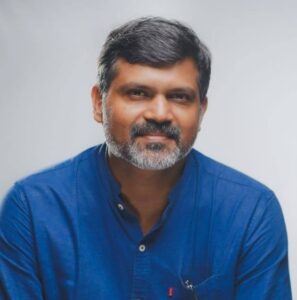 of the Srinivas Rayaprol Poetry Prize 2022, Syam Sudhakar is a bilingual poet who grew up in the Palakkad district of Kerala, India. Writing in both English and his native tongue, Malayalam, Syam has been widely published in a number of other languages, including Chinese, Hebrew, French, Tamil and Bengali. Earpam (Damp), Avasanathe Kollimeen (The Last Meteor) and Kadalinte Kavalkkaran (Keeper of the Sea) in Malayalam, Drenched by the Sun in English, Slicing the Moon (a bilingual video rendering),
Syam Sudhakar Kavithaikal (Poems of Syam Sudhakar) in Tamil and Samudrer Prahari in Bengali, are his major poetry collections. Muziris (in English) is his forthcoming collection. Other works have been published both online and offline, and he has also edited and translated several published works from English to Malayalam. Holding a PhD in English
Literature from the University of Madras, Syam is presently based in Kerala, researching and teaching English Literature at St. Thomas College, Thrissur. syamsudha@gmail.com
IVAN HERCEG
I Correspond
I correspond with the Universe.
I tell him: Stop!
Respect the words you’re made of.
But there is no answer.
As if the black holes
are the syllabaries for the chaos
I used to charm him.
I correspond with you
as the ghosts are peeling off my skin
bit by bit sticking them onto
the night sky.
Onto the canopy
covering your overvalued world.
How many letters are needed
for the dust to fill us inside
and to know how and where
this life disappears?
The Prophet’s Hut
They visit me only by night,
as I get number and number, shivering like an old man,
rambling something about my little
prophet’s hut, euphoria and rage.
Then they begin squeezing the air for blood,
howling defiantly like they’re suffering from some incurable illness,
mouths full of shimmering spawn.
They come from faraway places, the spheres
wherein the dead are embalmed with purest honey,
only to become the planting ground for high watchtowers.
They come to tell me
that words like war and death
are neither crazy nor cruel.
They just resemble the ground.
They always appear at night
and circle around me in their victorious formations
like pupils of marble snow.
Then they chase me down to the bottom
of the abyss – the black and white photographs
of screams, connecting and disconnecting frantically
inside that bodiless head.
The Body
The island kept eating at us from inside,
moaning and grinding at our veins and nerves,
like some phantom pirate’s sail.
Sitting in the road in a cobweb cocoon
you gave birth to a stillborn
crying madly in somebody else’s voice.
Blood was dripping down your thighs,
melting stones and ants
and in no time you were a mere bump on the road,
a strange body in clear dust.
I died for a moment reducing myself to nothing
as only a body can, but those cries,
oh, how hard they were.
Shattering our still warm eardrums,
our bones and skins into nobody’s mush.
And in a second, I was yours, reduced to nothing,
as only bodies can be.
Must I confess anything else?
The world contains as many worlds as deaths,
as many air pockets in the earth
conceived by rotten births.
We don’t need another one.
Warsaw, Warsaw
When you for the umptieth time
violated the Ten Commandments with me,
on the mythic side of night, without silver and light,
for all her desecrated tenants,
without a single treacherous noise,
I carried you over the edge into the past.
We were sunset carved into a cliff,
sloughed uterus.
And now as the dust covers that moment
and your mouth gapes open like Christ’s,
now you can scream all you want,
for now, you know that Curtis killed himself
because he couldn’t stop loving two women at once
as he watches blood dripping out of the speakers:
Warsaw, Warsaw, you damned city!
Do you also love two men,
and which one will you kill?
If you could hide life into a single word,
which one would you choose – crystal, cosmos,
blueness, irregularity or never?
Night People
You don’t want to talk
about your night people.
You keep them just for yourself.
Offering them to me only when I’m giving you
mouth to mouth like you were dead.
You say you haven’t met the right
man yet, that dark is flying
from one house to another
enveloping the infidels in blackness.
So, denounce the one
you still love,
there is no more reason
for suspicion or caution whatsoever.
IVAN HERCEG (1970),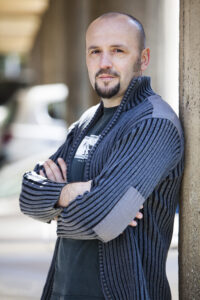 poet, prose writer, and editor, was born in Krapina, Croatia. He holds a BA in Croatian Language and Literature and South-Slavic Philology from the University of Zagreb. He is the editor-in-chief of the Zagreb-based journal Poezija, the editor-in-chief of Poezija Editions, and the organiser of the SUR (Stih u regiji / Poetry in the Region) Poetry Festival. He is the author of six books of poetry: Our Other Names (Zagreb, 1994); Night on Asphalt (Karlovac, 1996); Photographs of Earthly Sighs (Zagreb, 1997); Angels in Mourning (Zagreb, 2004); Irregularities (Zagreb, 2007); and When Will Babylon Arrive (Zagreb, 2013). He received several awards for his poetic work, IVAN HERCEG (1970), poet, prose writer, and editor, was born in Krapina, Croatia. He holds a BA in Croatian Language and Literature and South-Slavic Philology from the University of Zagreb. He is the editor-in-chief of the Zagreb-based journal Poezija, the editor-in-chief of Poezija Editions, and the organiser of the SUR (Stih u regiji / Poetry in the Region) Poetry Festival. He is the author of six books of poetry: Our Other Names (Zagreb, 1994); Night on Asphalt (Karlovac, 1996); Photographs of Earthly Sighs (Zagreb, 1997); Angels in Mourning (Zagreb, 2004); Irregularities (Zagreb, 2007); and When Will Babylon Arrive (Zagreb, 2013). He received several awards for his poetic work, most notably the Goran Prize for young poets, the Zdravko Pucak Prize, and the Rikard Jorgovanić Award. He also published Naked (Zagreb, 2011), a collection of short stories. His poetry has been widely anthologised and translated into a dozen languages, including Spanish, French, German, Italian, English and Chinese.
Kelley Jean White
Six True Things About Water
1.
my father was on a destroyer in the South Pacific
he remembered a great storm, the small boat
an acorn in a rocky pool
stirred by an angry child,
the men clinging
to her sides like bugs on a windshield
wiper, the roar
a locomotive in an bank vault
after my father retired he had time, he could spend
hours
in the town library with books
on World War II and naval history
he thought he had identified the storm
he read me a chapter
there is nothing to compare it to
2.
my father’s best friend on the ship was a boy
from Milwaukee
he had never seen the ocean
he could not swim
when they crossed the equator they had a certain
initiation
they were thrown from the ship, had to make
it to a ladder
my father tried to take his friend’s place
it was forbidden
the boy drowned
after my father retired he had time, he could spend
hours
Kelley White,
Six, page 2, continue same stanza
sorting through the tiny
brown edged pictures
there was the Chief Petty Officer crowned
as King Neptune
there was his friend laughing
he tried
but he could not remember that boy’s name
3.
my father knew at least 100 trout streams
once he rolled his canoe over
while he dried out by the fire he counted
the trout flies
on his hat band, 47,
on his vest, 218,
in his tackle box 808
when he bailed out his little boat he counted
47 buckets
after my father retired he had time, he could spend
hours
counting,
my mother didn’t want to hear the numbers,
things didn’t add up
my father always wanted to run the inland
waterway
he wanted to camp along Skyline drive
hike the Appalachian trail
after my father retired he had time, he could spend
hours
planning the trips
4.
money was tight
he sold his little boat,
his little silver
travel trailer,
Kelley White,
Six, page 3, continue same stanza
gave me the tent
I’ve driven Skyline drive
it was beautiful above the Shenandoah River
It was terrifying
my father never drank anything but water,
milk
and orange juice
occasionally a beer
but never before sunset
after my father retired he had time, he could spend
hours
sitting with his fishing buddies
but he never drank hard liquor
he didn’t drink coffee
never had a donut in his life
and men never talk
there is no need to speak by a waterfall
5.
my father taught himself about fish,
about rainbow trout,
brook trout,
brown, and
landlocked salmon
after my father retired he had time, he could spend
hours
researching the biology
of insect hatches,
the lateral line,
the visual system of fish
his legs gave out
he couldn’t hike into the best streams
Trout Unlimited brought in an expert
from Boston
who thought he knew more
than my father
6.
my father drank
from a colored only fountain in Alabama
he stayed innocent
he never learned to curse
in the South, in 1947, he gave his seat
to a Black soldier on a bus
he did not believe in divorce
he never thought you’d leave me
after my father retired he had time, he could spend
hours
worrying about me,
worrying about my children
watching me cry for months
he raised his fist to you
he didn’t believe in violence
he taught me never to hate anyone
he was seventy-three
he didn’t want to live with my failure
didn’t want to watch love
drift into despair
Pediatrician Kelley 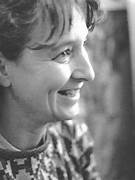 White has worked in inner city Philadelphia and rural New Hampshire. Her poems have appeared in Exquisite Corpse, Rattle and JAMA. Her recent books are TOXIC ENVIRONMENT (Boston Poet Press) and TWO BIRDS IN FLAME (Beech River Books.) She received a 2008 Pennsylvania Council on the Arts grant.