
Poetry in our Time
KESHAB SIGDEL (Nepal)
City and the Dreams
My city
Doesn’t have a face of its own;
Innumerable faces
Get painted to it every day,
And each new collage
Make a transient new face of this city.
My city
Doesn’t have a dream of its own;
Varied dreams
Envisaged by those countless faces
Merge and become a new dream of this city.
This city destined to witness
The shriveling of its own faith
Is but a conceited spectator
Of our glittering dreams in the peril.
Each day
Faces in the city’s stock
Silently jump into the dungeon of my mind
And navigates through
A long queue of the dreams–
The budding new dreams,
The fading ones,
The dead and the dumped
Along with a few young dreams
Waiting to board onto some promising new faces.
Though that face itself gets transmuted
It still thrives to identify itself
Among those many faces
Only to realize
That it looks like everyone else—
A simulacrum!
Identity
12 letters of my name, altogether, I thought,
form my identity.
I meditated upon my name.
My name
ALL IN BLOCK LETTERS
My name
In Small Letters With Initial Capitals
My name
in Times New Roman, Font Size 12
My name
with a Suffix
My name
with a Prefix
My name underwent a series of modulations
and became a farce!
Who am I?
A name!
But even the name
now I meditate upon
had long become a numeric entity.
1/147: the administration verifies the registration,
and confirms my identity;
2492318: the immigration tallies its record,
and verifies my nationality.
My name
refrains from identifying me;
My name
contributes to my vulnerability;
My name
only exhibits my non-existence.
This time, I silently chose
to unwrap the cover of my name
only to see my temporary identities
sink into the oblivion.
The Chess Game
The first move–
a white pawn takes a double leap.
Second,
the black horse jumps in L.
Moves and counter moves,
the game continues.
The dice that are on the move
have no intentions.
And those with intentions
do not speak their mind.
How long can a game continue?
It has to end.
One wins,
or it can end in a draw.
“Double check!”
Finally, someone speaks cautiously.
But it’s just a game,
and, you can play it again.
This time too,
I’m back on the chess board
re-arranged,
for the next game:
A mere di in flesh and blood!
x
Embargo
My daughter is learning numbers.
She is learning the names of the months and days.
She wants to do things on her own—
Like her father, like her mother.
And we keep saying,
“Not now dear, you are too small for it.”
Now she has a wish— a wish to grow
And not to be a child anymore;
Because she wants to do things on her own,
Like her father, like her mother.
And, on her third birthday, she tells me:
‘Baba, when I will no more be a child?’
To her, this asking is important.
It’s about a sense of freedom,
A sense of the self.
Becoming a teenager would mark her first transition.
For me, it is just counting of a few more years.
I add ten more years to her present age.
My daughter will be excitedly counting these more years
For they mean ten more birthday cakes,
And ten more birthday gifts,
Before she finally arrives at it.
Oh, this transition is scary.
She will be thirteen.
She will be assertive.
She will try to live on her own—
No more like her father, no more like her mother,
Different from what she aspired for.
And now, we fear the number.
We fear the possible assertion
Of her breaking away from us.
And with this fear,
We declare the number an embargo—
Ominous and Tabooed!
The Child and the Butterfly
(In memory of Palestinian children who lost their lives in war)
A child playing in the field
Halted in front of a wiry fence
The butterfly flying alongside him
Slipped through and soared skyward.
With a slight lift of the head
The child looked affixed at the sky
And saw in place of the butterfly
A smoke tailed missile
Coming straight at him.
And the child was lost amidst the smoke
But the fumes held steady
Farther and farther
Higher and higher
Like a butterfly
Like the child’s dreams
The aftermath saw no butterflies on the field
Neither the children
Tragedies came though
So did sky mystifying hatred
And the remnants of the ruptured dreams
The sun rose the same today
The Mediterranean summoned a tidal wave
That whisked away the smoke clouds
A thousand larvas are now growing in my head
And I now have a feeling
The child will resurrect again
To play with the butterflies!
But he must be a teen by now
So instead of a butterfly
He might brandish a flag
And say—Inquilab Zindabad!

KESHAB SIGDEL (1979) is a Nepali poet, editor, academic and rights activist. He is the author of Samaya Bighatan (2007), Colour of the Sun (2017) and Embargo (French translation by Alexandra Crette; 2025). He has edited Madness: An Anthology of World Poetry (Red Panda Books, 2023) featuring 297 poets from 101 countries/territories. He also edited a volume of Nepali poetry, An Anthology of
Contemporary Nepali Poetry (Big Bridge, 2016). His work of translation, Shades of Colour (Nepal Academy, 2021), is a collection of indigenous Nepali poetry. Besides poetry, he also writes fiction, literary essays and plays. He served as the Editor-in-chief of Poetry Planetariat, a global poetry magazine published by World Poetry Movement. He also co-edited Of Nepalese Clay, literary journal of the Society
of Nepali Writers in English and Rupantaran, a journal of translation published by Nepal Academy. Sigdel teaches Poetry and Literary Theories and Criticism at Tribhuvan University in Kathmandu.
Parismita Borah
Dear Diary
Oh dear diary,
He said he loves me too.
But now I see gashes and bruises
All over my heart and it’s crude
All of this daisies now turning
To look like crimson spikes
Blue streams down the eyes!
His words of disperse
My silence of guilt
Wracking my nerves
Burning my soul alive
He takes my name
With fury in his eyes
Oh dear diary,
Now I see no water left
In the pool of our love
He never really meant
What he penned in that poem
About me
Oh dear diary,
Now I let this plant die
I see no stars aligned
I sit beside the grave of our love
Watching all these memories rot.
Oh dear diary,
He used to say he loved me too!
Home
A little worn out house
Tinged in aquamarine.
Rooms getting bedraggled
We moved in with opaque hopes.
You painted it with shades of viridity
The neon lamp sat on the table,
Where once sat the sully oil lamp
Encaustic paintings hanging above
I said it looked comely, just like us.
Lavenders blossomed in the garden
Jasmine balm brushed up our bed!
You said you were making a house
Oh, how I laughed!
I said I was making a home
Shades of viridity washed off apace,
Aquamarine showed out
Dull and lamentable.
The sully lamp sits right there now
Paintings bearing god-awful ken
Garden turned to bushed land,
Lousy are the curtains
No light comes in!
You said you were adorning a house
Oh, what a disgrace!
I was adorning our love, until it turned out to be dust.
The House of Morgan
It wuz like a dead and gone eastern constructed dwelling
That resided left to where I had drawn my car to a halt.
In that entirely still road
As if the flash of those fireflies revamped
In the wight darkness
I walked towards,
The noise of crickets and frogs loomed along
The worn out signboard,it read
“…………..1970” all I could see.
As if the outcast place cried out for a human footstep inside it
I stepped in, shredding the dark after me
Monsoon of July scented with the Zephyrlilies’ balm
And my foot hit a hard entity-
A Portland limestone city of the dead!
My heart dropped a beat
Resonated under the macabre sky
A voice, stony-eyed…
“Death
shall be your last wish,
you can’t take to your heels
from
The House Of Morgan!”.
Let’s Call It The Kiss-Off So Long
Freed beems, light hearts
Love will come in buckets by and by
Welcoming tactions oscillate go around;
They can call it home
When I’m turned to dust in spite of all.
If they can laugh,
If they can cool it
If they can waive me on my own
Then I’ll be turned to dust in spite of all.
Let’s call it the kiss-off clash
Let’s call it the kiss-off cry
Let’s call it the kiss-off so long
For I’m turned to dust in spite of all!
Parismita Borah is  a surfacing writer who finds inspiration in fleeting moments and inner persuasion. Her work often explores themes of
love, distance, and self-discovery, with a focus on quiet, introspective expression.
Hemant Deolekar (Hindi)
Translated in To Englilish by Kamalakar bhat
A New Hunger
Even writhing with hunger,
man does not ask for bread.
He cries out—“speed, speed.”
Faster… faster—
why not faster than this?
An unreleased desire — speed is.
We have no memory of patience left,
anywhere in the world.
Everything arrives
in the blink of an eye.
All of modernity, at this moment,
is busy saving time—
time itself, a black hole.
Perhaps one day
we will even manufacture time.
But will we then
have enough time
to help a struggling insect
lying on its back
to turn over?
The Office
Since the Earth came into being,
there must have been an office.
Even if the world were to drown in an apocalyptic deluge,
the office, perhaps, will keep afloat.
More terrifying than a leech,
it clings to the soul
and drains away the very sap of life.
Without fear,
leave that ledger there—
so many centuries have been wasted;
it has never been settled.
Do not worry that your pocket will be emptied;
worry that your life is emptying out.
The whole Earth waits for you,
and you have mistaken a prison
for your world.
**
Harmony
White and black,
kept apart, become race;
together, they become music.
The harmonium
is an example of companionship.
The empty space between the fingers
is meant
to be filled by other fingers.
Hemant Deolekar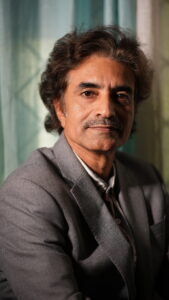
Poet and theatre artist, has three collection od poetry, still writing poetry focused on children. HIs poetry has been selected in the *Perennial* and many important collections. He is author of several original children’s plays: Little Revolutionary, Kites Fly High, Sad Slides, Birsa Munda, Forgetful and Scarecrow
2) Original play: Zoo, Story of Buddhinagar. He got awards and honor -1) Vagishwari Award of MP Sahitya Sammelan, year 2020, 2) Spandan Yuva Samman for Poetry, Bhopal, 2017, 3) State level Shashin Samman for poetry, Jabalpur year 2019. Currently working in theatre under the direction of Saurabh Anant at Vihaan Drama Works, Bhopal. Active in acting, songwriting, music creation, and training programs.
Email hemantdeolekar11@gmail.com
Prof. Kamalakar Bhat-
Prof. Kamalakar Bhat is  a professor and head of the postgraduate department of English of Ahmednagar College, Ahmednagar, Maharashtra. He is an award-winning bilingual writer, a columnist and a translator between English, Hindi, Marathi and Kannada. He has three collections of poems and three collections of translated verse in Kannada. He has edited three books in English. His essays and translations have appeared in Outlook magazine, Scroll.in, Wire.in, Muse India, Indian Literature, kitaab.org, indianculturalforum.com, The Bombay Literary Magazine and bengalurureview.com.