

Our Master
SHELLEY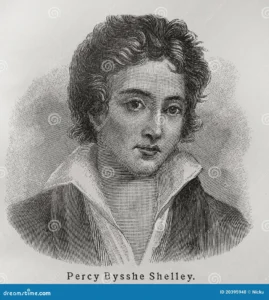
Percy Bysshe Shelley was born in 1792 at Warnham, Sussex. He had his first schooling at Sion House Academy, Isleworth, and at twelve was sent to Eton. At eighteen he went up to University College, Oxford, and about the same time his first book of verse appeared, Original Poetry by Victor and Cazire, written in part by his sister Elizabeth. After only five months Shelley, together with his friend Jefferson Hogg, was expelled from Oxford for publishing a pamphlet, ‘The Necessity of Atheism’. This event marked the beginning of his estrangement from his family. In 1811 he eloped to Scotland with Harriet Westbrook, an innkeeper’s daughter, and they were married in Edinburgh. For the next three years he and Harriet led a wandering life, and Shelley wrote scarcely any poetry apart from ‘Queen Mab’, concentrating instead on political prose works. A daughter, Ianthe, was born to them in 1813, but in the following year he and Harriet separated. Shortly afterwards Shelley left England with Mary Godwin, daughter of William Godwin, the philosopher with whom Shelley had been corresponding for some time. Harriet committed suicide in1816. During the last years of his life, Shelley lived in Italy, that ‘paradise of exiles’ as he called it. He was drowned in 1822 in the Bay of Spezia. when his boat was caught by a sudden and violent storm on his return from a visit to Byron and Leigh Hunt at Pisa. Shelley’s life and personality have provoked endless interest and discussion. Southey wrote of him: ‘With all his genius (and I think most highly of it), he was a base, bad man.’ But Byron, in a reply to the publisher John Murray, who thought Shelley ‘the vilest wretch now living’, wrote : ‘You were all brutally mistaken about Shelley, who was, without exception, the best and least selfish man I ever knew.’
THE INDIAN SERENADE
I arise from dreams of thee
In the first sweet sleep of night.
When the winds are breathing low,
And the stars are shining bright:
I arise from dreams of thee,
And a spirit in my feet
Hath led me — who knows how?
To thy chamber window, Sweet!
II
The wandering airs they faint
On the dark, the silent stream —
The Champak odours fail
Like sweet thoughts in a dream;
The nightingale’s complaint,
It dies upon her heart; —
As I must on thine,
Oh, beloved as thou art!
III
Oh lift me from the grass!
I die! I faint! I fail!
Let thy love in kisses rain
On my lips and eyelids pale.
My cheek is cold and white, alas!
My heart beats loud and fast;
Oh! press it to thine own again,
Where it will break at last.
TO SOPHIA (MISS STACEY)
Thou art fair, and few are fairer
Of the nymphs of earth or ocean;
They are robes that fit the wearer —
Those soft limbs of thine, whose motion
Ever falls and sifts and glances
As the life within them dances.
11
Thy deep eyes, a double planet,
Gaze the wisest into madness
With soft clear fire, — the winds that fan it
Are those thoughts of tender gladness
Which, like zephyrs on the billow,
Make thy gentle soul their pillow.
III
If whatever face thou paintest
In those eyes, grows pale with pleasure,
If the fainting soul is faintest
When it hears thy harp’s wild measure,
Wonder not that when thou speakest
Of the weak my heart is weakest.
IV
As dew beneath the wind of morning,
As the sea which whirlwinds waken,
As the birds at thunder’s warning,
As aught mute yet deeply shaken,
As one who feels an unseen spirit
Is my heart when thine is near it.
LINES
I
The cold earth slept below,
Above the cold sky shone;
And all around, with a chilling sound,
From caves of ice and fields of snow,
The breath of night like death did flow
Beneath the sinking moon.
II
The wintry hedge was black,
The green grass was not seen,
The birds did rest on the bare thorn’s breast,
Whose roots, beside the pathway track,
Had bound their folds o’er many a crack
Which the frost had made between.
III
Thine eyes glowed in the glare
Of the moon’s dying light;
As a fen-fire’s beam on a sluggish stream
Gleams dimly, so the moon shone there,
And it yellowed the strings of thy raven hair,
That shook in the wind of night.
IV
The moon made thy lips pale, beloved —
The wind made thy bosom chill —
The night did shed on thy dear head
Its frozen dew, and thou didst lie
Where the bitter breath of the naked sky
Might visit thee at will.
OZYMANDIAS
I met a traveller from an antique land
Who said: Two vast and trunkless legs of stone
Stand in the desert… Near them, on the sand,
Half sunk, a shattered visage lies, whose frown,
And wrinkled lip, and sneer of cold command,
Tell that its sculptor well those passions read
Which yet survive, stamped on these lifeless things,
The hand that mocked them, and the heart that fed:
And on the pedestal these words appear:
‘My name is Ozymandias, king of kings:
Look on my works, ye Mighty, and despair!’
Nothing beside remains. Round the decay
Of that colossal wreck, boundless and bare
The lone and level sands stretch far away.
INVOCATION TO MISERY
Come, be happy! — sit near me,
Shadow-vested Misery:
Coy, unwilling, silent bride,
Mourning in thy robe of pride,
Desolation — deified!
II
Come, be happy! — sit near me:
Sad as I may seem to thee,
I am happier far than thou,
Lady, whose imperial brow
Is endiademed with woe.
III
Misery! we have known each other,
Like a sister and a brother
Living in the same lone home,
Many years — we must live some
Hours or ages yet to come.
IV
‘Tis an evil lot, and yet
Let us make the best of it;
If love can live when pleasure dies,
We two will love, till in our eyes
This hearts Hell seem Paradise.
V
Come be happy! — lie thee down
On the fresh grass newly mown,
Where the Grasshopper doth sing
Merrily — one joyous thing
world of sorrowing!
VI
There our tent shall be the willow,
And mine arm shall be thy pillow;
Sounds and odours, sorrowful
Because they once were sweet, shall lull
Us to slumber, deep and dull.
VII
Ha! thy frozen pulses flutter
With a love thou darest not utter.
Though art murmuring — thou art weeping —
I thine icy bosom leaping
While my burning heart lies sleeping?
VIII
Kiss me— oh! thy lips are cold:
Round my neck thine arms enfold —
They are soft, but chill and dead;
And thy tears upon my head
Burn like points of frozen lead
IX
Hasten to the bridal bed —
Underneath the grave ‘tis spread:
In darkness may our love be hid,
Oblivion be our coverlid —
We may rest, and none forbid.
X
Clasp me till our hearts be grown
Like two shadows into one;
Till this dreadful transport may
Like a vapour fade away,
In the sleep that lasts alway.
XI
We may dream, in that long sleep,
That we are not those who weep;
E’en as Pleasure dreams of thee,
Life-deserting Misery,
Thou mayst dream of her with me.
XII
Let us laugh, and make our mirth,
At the shadows of the earth,
As dogs bay the moonlight clouds,
Which, like spectres wrapped in shrouds,
Pass o’er night in multitudes.
XIII
All the wide world, beside us,
Show like multitudinous
Puppets passing from a scene;
What but mockery can they mean,
Where 1 am — where thou hast been?
TO THE MOON
Art thou pale for weariness
Of climbing heaven and gazing on the earth,
Wandering companionless
Among the stars that have a different birth, —
And ever changing, like a joyless eye
That finds no object worth its constancy?
Thou chosen sister of the Spirit,
That gazes on thee till in thee it pities
TIME
Unfathomable Sea! whose waves are years,
Ocean of Time, whose waters of deep woe
Are brackish with the salt of human tears!
Thou shoreless flood, which in thy ebb and flow
Claspest the limits of mortality,
And sick of prey, yet howling on for more,
Vomitest thy wrecks on its inhospitable shore;
Treacherous in calm, and terrible in storm,
Who shall put forth on thee,
Unfathomable Sea!
FROM THE ARABIC: AN IMITATION
My faint spirit was sitting in the light
Of thy looks, my love;
It panted for thee like the hind at noon
For the brooks, my love.
‘rhy barb whose hoofs outspeed the tempest’s flight
Bore thee far from me;
My heart, for my weak feet were weary soon,
Did companion thee.
II
Ah! fleeter far than fleetest storm or steed,
Or the death they bear,
The heart which tender thought clothes like a dove
With the wings of care;
In the battle, in the darkness, in the need,
Shall mine cling to thee,
Nor claim one smile for all the comfort, love,
It may bring to thee.