


Poetry in Our Time
Sonnet Mondal (English)
Grandpa’s Veranda
Grandpa used to sit on a protrusion
of the veranda in our old house.
He used to nod subtly
to acquaintances walking by—
ploughing time—looking from across the road.
I remember him from his last days,
mostly lying on the bed he had slept on
for more than six decades.
These days I often sit in the new open balcony
of our house. A few people wave at me.
A few smile and some just walk by.
I will be sitting here till they remain
just like Grandpa still sits in his veranda
in the eyes of those who have seen him there—
an unavoidable view of places we inhabit,
an inconsolable coffin much before we depart.
The Curved Road Home
Yesterday the lights went out at midnight
and the slackening ceiling fan
added music to my heavy-eyed muse
stretched like a wire between the two shafts
of anguish and faith.
I couldn’t move. The dragged-up stillness
failed to give me back my stolen sleep.
The ticking wall clock felt purer
than the falling dusk of winter.
Its pulse took me to the narrow curving road
leading to my old house in Sripur
from the village bus stop.
All these passing moments
broke through my window like snow.
They kept refreshing me
like wafts of rain-soaked air.
I thought
not to visit that road ever
for I cannot be that child again
walking to the door
I expect someone to open.
My legs were not on the ground
and I was not flying either.
Note: Sripur is a village in West Bengal, India
Preserved in a Corner
Some roads are like moments—
they linger like the setting sun
in an overcast horizon
and these roads
sometimes lead to lifeless houses
that died together with their dwellers.
The moments too retire
like escaping gas balloons
like broken words tossed in an echo.
A few walls might still have them
knitted with the silk of longing—
with memories smoking darkness in a frame.
 Sonnet Mondal writes from Kolkata and is the director of Chair Poetry Evenings – Kolkata’s International Poetry Festival. His ten books of poetry include Clamour for a Handful of Rice (Copper Coin), An Afternoon in My Mind (Copper Coin), and Lautati Dopaharein (Rajkamal Prakashan). He has read as an invited poet at literary festivals in more than thirty countries, and his works have been translated into over twenty languages. His recent works have appeared in The Harper’s Bazaar, Virginia Quarterly, Stand magazine, Versopolis, and The Markaz Review. His honours include an Award of Honour from the Chandigarh Sahitya Akademi and the Gayatri Gamarsh Memorial Award. He was a part of the Silk Routes Project, IWP IOWA, and a guest writer in residence at the Almaty Writing Residency. He is the managing editor of Verseville, editor of the Indian section of Lyrikline, and has served as a guest editor for Words Without Borders.
Prafull Shiledar (Marathi)
A Poet in the Riot
On a quiet lonely night
Low shouts of the beginning of a riot
Are heard from the middle of a city
Sprawled distantly
Slowly the shouts become distinct
Familiar voice of everyone since long
Can be recognized
That’s full of absolutely strange excitement
After the riot begins
Every person runs separately in great rush
And the mob humming like wild bees
Keeps following
In the hands of the mob there are weapons
Like rusted swords and sticks
And sharp knives and country daggers in a village
Or anything up to guns & rifles in a city
One by one the organs of desolate person
Caught in the grip of the mob fall limp
Getting blood it suddenly wriggles
Like a bird about to fly
On the deep slope of terror
The tremulous hearts keep rolling
The rising tumult stops at my door
Pull him out
Burn that bastard alive
Such shouts begins for me
With that a herd of fox
Pass trembling over me
I pull my legs
close to my stomach
Close my fists tightly
Begins to collapse limitless deep
Scratching that cut through and through
With abrupt bang on the glared floor
Someone from the mob
Holding at my neck
Help me to get up
Waves of the mob wrestle with my body
Ripping my skin off
The mob tries to search
The hereditary color of my blood
Breaking the walls of the house
The mob sniffs in every brick of the house
To search the provincial scent of the soil
The mob peels off the skin
even of my language
and tastes the accents
At last turning back
It searches for
all the useful things one by one in the house
Taking aim the mob smashes
The transparent glittering chandeliers
Preserved by me for so many years having innate pull
Trampling over the scattered pieces of glass
The mob begins to run madly once again
Leaving red impressions of bloody feet behind
For the generations to come
(Translation by Santosh Bhoomkar)
The Silent Killer
He is the most vigilant amid the crowd
Most alert and most disciplined man
Stuffing all verbosity inside, he has pulled the zip
And is silent
He is always trying to change his appearance
But he cannot change is eyes
Which even he cannot realize
His determined steps go on the chartered path
When crowd around is busy establishing bonds
He alone goes on fluttering the pages of history
A legion is at work behind him
With whose rope of threat, he is fastened with
All around him a restless present is bubbling
He is a part of a headless animal
That has come up here
Sniffing the path without eyes
It is ensured that there is always
a killer instinct alive in him
And it would never get doused
He has been immunized against humanity
He has put on a jacket that will protect him
from piercing human touch
His cold eyes inflicted with deadly disease
make him feel the human crowd as worms in sewage
The whirlwind roaring through his ears
will penetrate in his body
and he will start the action
determinedly anytime
I have identified him unexpectedly amid this jostle
He is just next to me rubbing my body
holding the overhead hook of the running local train
Now there can be explosion any moment
(Translation by Santosh Bhoomkar)
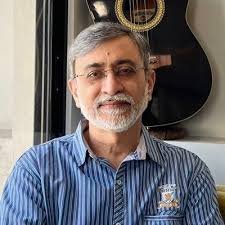 Prafull Shiledar is a prominent voice in contemporary Marathi poetry. He has four Poetry volumes in Marathi, two in Hindi, six translated books, six edited books and a book of non-fiction writing. Volumes of his poetry in translation are published in English, Kannada and Punjabi. His poems are translated into many other languages including Malayalam, Telugu, Odia, Gujarati, Nepali, Manipuri, Dakhani, Slovak, Turkish & German. He is the recipient of Kavi Keshavsut award, Kavi Kusumagraj Award award for his poetry. He writes in Marathi and Hindi. He has translated Indian, European, American, Latin American poetry into Marathi and Hindi. He is the recipient of Sahitya Akademi translation award, Balshastri Jambhekar award, Gandhi Smarak Nidhi award for translation. He was the editor of the Marathi literary quarterly ‘Ýugvani’. He has read poetry across India, Europe, USA and Middle East. He was a fellow writer in the International Writer’s Residency Program organized by Art Omi, New York during Spring 2025. / shiledarprafull@gmail.com)
Bahtiyar Hidayet, Azerbaijan
A Letter from Hell
One day, somehow,
A letter came to the UN from Hell.
“…Dear rulers of the world,
We have a request from you:
Technology has already developed there too,
sins are measured with a modern device.
Now there is a sin device that,
like the hands of a clock,
the more times it turns,
the greater the person’s sin becomes.
Sometimes send politicians here,
send sycophant poets,
and send fake patriots.
Then the hands of the devices
spin like a fan,
and a little coolness comes
to this fiery Hell.”
2
Your eyes, too,
Could be sorrowful;
your eyes no longer devour people,
your eyes are fasting,
your eyes have become devout.
On your chest are twin minarets,
your chest has also become devout.
Your feet—angels on shoulders,
and under your feet is paradise;
from head to toe
you are a believer.
But your bottle-shaped legs
prove that you are truly like wine—
as years pass, your effect grows.
Both believer and infidel—
is this a new kind of transness?
3
Sparrow Love
So what if
your face is like a flower garden?
My heart, meanwhile, is like a beehive —
your longing has thousands of nests inside me.
And I am allergic to bee venom.
Its medicine is analgin, dimedrol.
Or can you not be
as much as analgin and dimedrol?
The flowers on your face have no nectar,
like artificial flowers
laid upon graves.
I already have diabetes.
I could feed this beehive with sugar too.
Artificial honey would come out.
Besides, everything in this country is artificial.
Let the harvest of my sorrow be artificial too.
Your love is artificial anyway.
But fake analgin and dimedrol do not exist —
because they are too cheap.
Look, on the balcony, swallows
build nests with their mouths.
But the mouths of people like you
destroy homes, destroy nests.
By now I love bees more than people,
I love swallows,
I love cheap medicines.
Be as jealous as you want.
…There are grave flowers on your face.
So many wishes have died inside you,
woman like a homeland.
You are like a homeland.
But I, miserable as I am,
cannot even become a swallow.
I am like a sparrow.
On the crater-like roads
of this ruined homeland,
I foolishly treat muddy puddles
like jacuzzis.
I am like a sparrow.
It is only my sorrow
that makes me look big.
Bahtiyar Hidayet 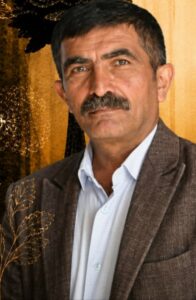 — Born in 1974 in the Gazakh district of Azerbaijan. He is a historian and an experienced educator with 28 years in pedagogy. He is the author of four poetry collections: The Hem of Grief (2003), White Darkness (2012), Tecnises (2025), and The Closest Star (2025). Alongside traditional national poetic forms, he uses his own invented structural form called “cross-tecnis.” His poems have been translated and published in the USA, Italy, Pakistan, India, Egypt, and Albania.