
In The Name Of Poetry
John Guzlowski
Hunger in the Labor Camps
1. What My Father Ate
He ate what he couldn’t eat,
what his mother taught him not to:
brown grass, small chips of wood, the dirt
beneath his gray dark fingernails.
He ate the leaves off trees. He ate bark.
He ate the flies that tormented
the mules working in the fields.
He ate what would kill a man
in the normal course of his life:
leather buttons, cloth caps, anything
small enough to get into his mouth.
He ate roots. He ate newspaper.
In his slow clumsy hunger
he did what the birds did, picked
for oats or corn or any kind of seed
in the dry dung left by the cows.
And when there was nothing to eat
he’d search the ground for pebbles
and they would loosen his saliva
and he would swallow that.
And the other men did the same.
2. What a Starving Man Has
He has his skin. He has a thinness
to his eyes no bread will ever redeem.
He has no belly and his long muscles
stand out in relief as if they’d been flayed.
He is a bony mule with the hard eyes
one encounters in nightmares or in hell,
and he dreams of cabbage and potatoes
the way a boy dreams of women’s breasts.
They come uncalled for, round and fevered
like rain that will never stop. There is always
the empty sea in his belly, rising
falling and seeking land, and next to him
there’s always another starving man who says,
“Help me, Brother. I am dying here.”
3. Among Sleeping Strangers
The moon set early and it grew darker,
and the men settled to sleep in the cold
without blankets. Soon it would be spring
but it was still cold, and it was always cold
at night, and they did what men always did
at night when they were cold. They pressed their bodies
together and looked for warmth the way a man
who has nothing will look, expecting nothing
and thankful to God for the little he finds,
and the night was long as it always was
and some men crawled roughly across the others
to reach an outside wall to relieve themselves,
and some men started coughing and the coughing
entered the dreams of some of the other men
and they remembered the agony
of their mothers and grandfathers dying
of hunger or cholera, their lungs coughed up
in blood-streaked phlegm, and some men dreamt
down deeper and deeper against the cold
till they came somehow to that holy moment
in the past when they were warm and full
and loved, and the sun in those dreams rose early
and set late and the days were full of church bells
and the early spring flowers that stirred their lives
and in the morning the man shook away
from the cold bodies of their brothers
and remembered everything they had lost,
their wives and sisters, their lovers, their homes
their frozen fingers, their fathers, the soil
they’d been born on, the souls they’d been born with,
and then they crawled up out of the earth
and gathered together to work in the dawn.
4. The Germans
These men belonged to the Germans
the way a mule belonged to the Germans
and the Germans stood watching
their hunger and then their deaths,
watched them as if they were dead trees
in the wind, and waited for them to fall,
and some of the men did. They sank
to their knees like children begging
forgiveness for sins they couldn’t recall,
or they failed to rise when the others did
and were left in the wet gray fields
where the Germans watched them
and the Germans stood watching
when the men who were still hungry
came back and lifted the dead men
and carried their thin bones to the barn,
and buried them there before eating the soup
that wouldn’t have kept them alive.
The Germans knew a starving man
needed more than soup and more than bread
but still they stood and watched.
My Name
for Victor Contoski
My name arrived from Poland in 1910 stowed away
in the engine room of a Swiss freighter. The cook
took pity on it and every day brought sausages,
berries and milk. My name for two weeks was deafened
by the sound of pistons and the turning of the ship’s screw.
My name, without a passport or extra change of clothes,
without a tooth brush or brown shopping bag,
swam to Staten Island, barely missed being eaten
by sharks. My name didn’t know English.
It was taken in by potato farmers and learned
to drive trucks and drink beer. My name tripped
over a cabbage and was cut in half by a harrow.
Thus I was born. I have given it years of pain.
My name has forgotten how to cry.
“My Name” was originally published in The Spiders (New Rivers, 1979). It has subsequently been published in a number of anthologies. “Letter to Serafin,” the title poem for the forthcoming collection from the University of Akron Press (Publication planned for the summer of ’09), was originally published in Fourth River.
Over a writing career that spans more than 50 years, John Guzlowski has amassed a significant body of published work in a wide range of genres: poetry, prose, literary criticism, reviews, fiction and nonfiction.
His poems, stories, and critical essays have appeared in such national journals as North American Review, Ontario Review, Rattle, North Dakota Quarterly, Modern Fiction Studies, The Polish Review, Polish American Studies, and Studies in Jewish American Literature.
His published books of poems include Language of Mules, Jezyk mulów i inne wiersze, Echoes of Tattered Tongues, True Confessions, Mad Monk Ikkyu, and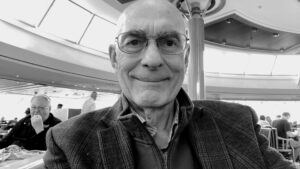 Small Talk: writing about God, writing and me. His novels include Retreat: A Love Story and the Hank and Marvin mysteries: Suitcase Charlie, Little Altar Boy, and Murdertown. He is also a columnist for the Dziennik Związkowy, the oldest Polish newspaper in America. Who I Am: Lives Told in Kitchen Polish, a collection of his columns, was published by the Polish American Historical Association.
In reviewing Guzlowski’s book Language of Mules, Nobel Laureate Czeslaw Milosz wrote, “Exceptional…even astonished me…reveals an enormous ability for grasping reality.”
Born in a refugee camp in Germany after World War II, Guzlowski came to America with his family as a Displaced Person in 1951. His parents had been Polish slave laborers in Germany during the war. Growing up in the tough immigrant neighborhoods in Chicago, he met hardware store clerks with Auschwitz tattoos, Polish cavalry officers who still mourned for their dead horses, and women who had walked from Siberia to Iran to escape the Russians. In much of his work, Guzlowski remembers and honors the experiences and ultimate strength of these voiceless survivors.
Guzlowski received his B.A. in English Literature from the University of Illinois, Chicago, and his M.A. and Ph.D. in English from Purdue University. He is a Professor Emeritus of English Literature at Eastern Illinois University, and currently lives in Lynchburg, Virginia.