
Poetry In Our Time
A Poem by John Minczeski
My Name
for Victor Contoski
My name arrived from Poland in 1910 stowed away
in the engine room of a Swiss freighter. The cook
took pity on it and every day brought sausages,
berries and milk. My name for two weeks was deafened
by the sound of pistons and the turning of the ship’s screw.
My name, without a passport or extra change of clothes,
without a tooth brush or brown shopping bag,
swam to Staten Island, barely missed being eaten
by sharks. My name didn’t know English.
It was taken in by potato farmers and learned
to drive trucks and drink beer. My name tripped
over a cabbage and was cut in half by a harrow.
Thus I was born. I have given it years of pain.
My name has forgotten how to cry.
“My Name” was originally published in The Spiders (New Rivers, 1979). It has subsequently been published in a number of anthologies. “Letter to Serafin,” the title poem for the forthcoming collection from the University of Akron Press (Publication planned for the summer of ’09), was originally published in Fourth River.
A Letter to Serafin
Serafin, orphaned angel,
all that’s left is a few pigs,
some rutabagas, and winter wheat.
Your great-grandchildren,
heirs to your legacy of dirt,
cultivate dialects like snow.
I am speaking from a suburb of St. Paul.
It is October. I am not raking
or composting. Nothing remains the same-
a galvanized roof shines on top of your house;
nobody has time for thatching anymore-
yet everything is the same.
The family, having gathered beets,
came from hunting mushrooms
to set out sausage and relishes.
What was I doing there, they asked,
how old was I? More tea?
Vodka? And everything made by hand-
you-d feel at home.
They laid out inventories from the war-
a hand blown off by a land mine in the field,
a father who walked home from Germany
more bone than flesh.
Bankruptcies keep filtering down-
stifled inheritances,
a grimace mistaken for a smile.
The animals remain-pigs, a cow staked out
in a field to graze-descended from those
you fed, who adored you,
whoever you were, Serafin.
John Minczeski’s 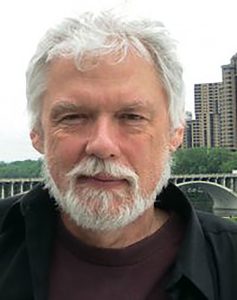 fifth full-length collection, A Letter to Serafin, will be published by the University of Akron Press in Summer, ’09. He is also the author of several chapbooks (November, Finishing Line Press, ’07 and Grass Elegy Red Dragonfly Press, ’07), and his poems have appeared in journals around the US. He is the editor of Concert at Chopin’s House: A Collection of Polish-American Writing, published by New Rivers Press in 1988. He lives in St. Paul, Minnesota.
Leonard Kress
O Anandziu, “The Bird Flew Away”
The poet reads aloud, a South Indian language
I’ve never heard of. But here in Warsaw
it’s translated into Polish-declaimed
by a washed-up TV actor whose last role
was Solidarity Informer. Who can blame
him, dumping vodka into his glass of tea?
He must follow a dread host of speeches,
followed by a string quartet from
State Higher School of Music # 5,
cellist in black with her chain-link belt,
over-dyed black hair she shakes from her eyes.
They play something irrepressibly Polish,
waltz, mazurka, polonaise competing
for the prize. She could be my daughter wringing
Bourees from Bach’s Unaccompanied Suite
in the next room as I stick cinnamon into the curry.
Now it’s Buddha’s beloved disciple Ananda
who has the parquet floor, tempted by a young
village girl drawing water from the well. (Don’t
get me started about sources…) In the time it takes
to empty the small bucket into the larger one,
she’s already in love with him-barefoot, saffron-robed,
head shaved, “O Ananda,”she cries, “Renounce your vows.
What good is perfect bliss compared to my love?”
He leaves–not bothering to glance back, as she struggles
to hoist and balance the yoke of laden buckets-
chanting from his sutra, The bird flew away…
CAFE HAVELKA, VIENNA
After Baudelaire
What do you think you’re doing? Who do you think
you are? You are not sitting in this cafe
dazed and euphoric on cigarettes and wine
about to share some slivovice, squandering
your guaranteed student loan on a tour
of mitteleuropa. And she is not some eager
wide-eyed girl from Krakow, studying
English Philology, here because
her father’s a party functionary, able
to afford travel abroad. And she is not
about to invite you back to her upper bunk
in the student hotel she shares with her band
of English-mangling friends eager to talk rock.
Oh, you I would have loved, oh you who knew it too
“Cafe Havelka, Vienna” originally appeared in The Orpheus Complex.
BIO
Leonard Kress has published four books, most recently The Orpheus Complex (Main Street Rag). He has also translated Pan Tadeusz of Adam Mickiewicz. He teaches philosophy, religion, and creative writing at Owens College in Ohio.
Oriana Ivy
IN BLACKBERRY WOODS
Blackberry bushes
scrape one side of the tracks,
the train stopped in the woods
by the semaphore’s arm.
My father jumps out.
In his cupped hands he brings me
blackberries warm from the sun.
The sweetest, the blackest
he brings me. He pours
the glistening
berries into my hands.
I’m eating the black sun.
Father goes to pick more
and I know he’ll be left
behind — a flash of his shirt
in thorn-studded brambles,
at the window my mute
screaming mouth. But the train
blows a whistle for the fathers,
lost: he jumps back onboard,
and like a slow waltz,
rocking side to side,
in blackberry woods
we begin to keep time,
lips stained with
departing purple.
*
VERLOREN
My first memory of German
six years old, running
through our Łodź apartment
chanting Heil Hitler
Hände hoch
petrified parents
plucking the exotic
bloodied syllables
from my happy mouth
but when I was sixteen
my neighbor from Silesia
called me Fräulein Yoasia
she taught me the caress of umlauts
long journeys of Wehmut
leiden and verloren
that music of sorrow
I stood under those vowels
as in a petal-fall
Ich bin verloren I whispered
in secret to myself
in the language of the enemy
described all around me
as “subhuman barking”
*
What verloren means
a Mazurian village
a woman bows like wheat
as she opens the door
on the table she puts
milk and honey and home
-churned butter
bread fragrant with the summer sun
white lace blooms
in the windows
saints on the
lime-washed wall
*
Memory is a translation
from a dead language
she waits for us forever
that shimmering young girl
Ich bin verloren
she whispers
lost mouths that kiss us
as we pass
**
ATLANTIS
We’re wreathed in robes of seaweed,
air bladders’ amber beads,
the hood of water
over the face of things.
Fish weave in rainbow veils.
Kelp sways like soundless bells.
We cannot tell one day
from a thousand years.
Here are our amulets,
diadems and crowns.
Here tilts the headless
statue of our god,
the Lord of Mercy in whose name
we killed. Worms burrow
in the marble palaces.
Our purses fill up with silt.
We remember pine forests,
resin scent of the wind.
We remember having held
someone’s hand.
This glitter on the waves
like bent echoes,
those are our last words:
Hold hands. Hold hands.
Oriana Ivy 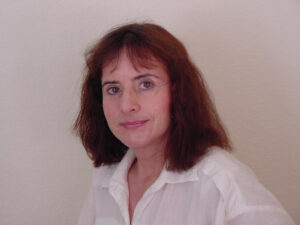 was born in Poland, and came to this country when she was 17. Her poems, essays, book reviews, and translations include Poetry, Ploughshares, Best American Poetry, Nimrod, Spoon River Review, The Iowa Review, Black Warrior Review, and many others. Her early collection, No Longer Mine, won the Sow’s Ear Chapbook Contest, and her April Snow, won the Finishing Line Press 2011 chapbook contest. Other chapbooks include Stalin’s Mustache, From the New World, and How to Jump from a Moving Train. Her first full-length collection bears the title Paradise Anonymous. A former journalist and community college instructor, she edits the online Poetry Salon and writes a weekly poetry-and-culture blog. She lives in the San Diego area of Southern California, near the border with Mexico.
Maja Trochimczyk
WHAT TO CARRY
You never know when the war will come,
her mother said. You have to be ready.
Most things are unimportant.
You must take your gold, your family jewels.
Diamonds will buy you food.
Gold will save your life. Forget silver, too heavy.
Take sturdy boots with two pairs of socks,
a warm, goose-down comforter on your back,
one picture, no books. Leave it all.
You will have to walk, sleep in a ditch, walk.
Pack lightly. What you carry, will protect you.
From starving, from freezing. That’s what matters.
Goose-down and gold. Hunger and snow.
She still has her goose-down coverlet,
useless in California. Her mother squished it
into a suitcase the first time she came to visit.
The down came from geese plucked decades ago
in Bielewicze, by her Grandma, Nina.
Diamonds? She sold her rings
to pay for the divorce, keep the house
with pomegranates and orange trees.
Her shoes are useless too –
a rainbow of high heels in the closet.
first published in The Rainy Bread: Poems from Exile (2016)
SHAMBHALA
Do children who die on the way
carry bejeweled parasols in a Tibetan heaven?
Is Siberia too far from Shambhala
for the bedraggled orphans to enter through
its golden doorways, glistening with ten thousand
ornaments, treasures from a galaxy with ten billion suns?
Are they too sick and dirty to walk on a shining path
made for the birth of the Buddha — scented
with sandalwood, adorned with an unsurpassed
multitude of rarest gems.
When the Buddha was born, the Earth
moved six ways, the wise man said.
Did it move at least once to mark your passage?
When you rolled in pain and moaned
until the blessed moment of relief?
Gave up your last breath like a crystal question mark
in a frozen Siberian air? Convulsed
in a sudden burst of gunfire, a bullet straight
through your heart? Froze to death in a convoy?
Fainted on the floor of a railroad car?
There was no hooting of owls, they say,
when the great Shakyamuni Buddha
was born. Sweet sounding music floated
through a myriad of flowering orchards,
filled with a rainbow of gemstone trees.
Did you hear an owl hoot when you died?
Oh, hungry child of gulags, the lost child
of Siberia — Did the Earth move?
Were there parasols, or owls?
first published in The Rainy Bread: More Poems from Exile (2021)
ARBOR COSMICA
~ for my children
No fear, no hate, not even a mild dislike*—
we leave our heavy burdens, shards of memories
broken, all too broken, at the bottom of crystal stairs
beneath clouds of white camellias, petals swirling
through air like the snow of forgetfulness
Perfect symmetry of blossoms
points the way—up, up, always up
rainbow crystal stairs, revealed
one by one as we ascend—inwards,
outwards—dancing spirals of our DNA
We get to know this place—these depths,
these heights—for once, for all lifetimes
With each step, pure notes resonate
and expand into clear, spacious chords—
the music of the spheres rings out, wave by wave
expanding from our open hearts
Each chord—harmonious, different—
each melody in this vast symphony
sweetly twines around another, and another
until all are One Song, One Wisdom—
of stem and flower, of leaf and root
in this Cosmic Tree of humanity
Arbor Cosmica—
We have been here
all along without knowing
First published in the California Quarterly 46:4, 2019
Maja Trochimczyk is a Californian poet, scholar, translator, photographer, and non-profit
director from Poland. She studied musicology at the University of Warsaw, sound
engineering at the Chopin Academy of Music in Warsaw, and earned her Ph.D. in musicology
from McGill University in Montreal, 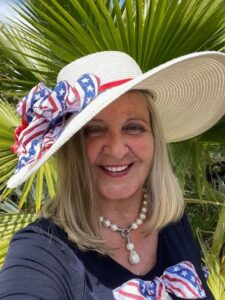 Quebec, Canada in 1994. Dr. Trochimczyk published six
books of poetry (incl. The Rainy Bread, 2016, and Bright Skies, 2022). She also edited five
poetry anthologies: Chopin with Cherries (2010); Meditations on Divine Names (2012),
Grateful Conversations (2018), We Are Here. Village Poets Anthology (2020), and Crystal
Fire. Poems of Joy and Wisdom (2022). HHundreds of her poems and articles appeared in
numerous journals and anthologies in English, Polish, and translations. She published
ten books of music history research, and hundreds of articles on music, immigration, and
Polish culture. Twice nominated for the Pushcart Prize, Dr. Trochimczyk is a recipient of
PAHA's Creative Arts Prize (2016) for her two poetry books about WWII experience of
civilians, Slicing the Bread, and The Rainy Bread. She has served as President of
California State Poetry Society since 2019 and as Managing Editor of the California Quarterly
since 2021. Established in 2008, her small publishing houses, Moonrise Press, issued
36 books of poetry and Polish culture studies so far.